Nonprofit Boards: Reacting to the Ever-Changing Landscape (Part II)

From the previous blog, I had come across an interesting quote at the Nonprofit Summit sessions that took place in Banff on April 27&28. It stated that "Culture Eats Strategy for Breakfast." Talking about culture and boards .. and how they project it .. and how it gets back at them is definitely a subject worth discussing in my upcoming blog post.
But for the time being, let us focus on "Strategy" ..

The moment before how the organization's culture would support or hinder its strategy, is simply a happy one! A moment of energy, enthusiasm, and high hopes. The board members are full of positive thoughts and energy that they are writing history and strategizing to get all the funding they lay an eye on .. and programming like never before .. etc. The organization's culture is what will decide whether this will be a decisive moment of change, or things will continue as is, if not worse. We'll talk about that in the upcoming Part III of this blog series.
So the time being, lets focus on the moment of deciding a hopeful better future, that we're shaping together, for the organization. It is a moment of inspiration in which board members see themselves as storytellers, bridge-builders, and cultural ambassadors. They believe that their committed action for this strategic plan development will lead to: ● Amplifying their voices through arts & culture
● Creating spaces for connection and belonging
● Building bridges across cultures
They hope for
● Successful events and community engagement
● Growing recognition
● Strong cultural relevance
But they are aware of some challenges they might encounter:
● Limited resources
● Capacity constraints
● Need for long-term direction
This is happening while the world around them is changing .. fast. For instance:
● Arts funding is competitive
● Audiences are changing
● Digital engagement is essential
● Communities are seeking identity and connection
But they are still hopeful that there is still an opportunity at the end of this dire strait:
Opportunity: Our work has never been more needed
Fine! Let's continue .. and I really hope the readers are not dissuaded by the seemingly ironic language. I have no doubt that the strategic planning is the answer if coupled with serious commitment from the board. It is not a one-time board activity that will be swept under the rug after paying the expert leading the exercise. The irony might be in the next blog post if this commitment is lost.
When we talk about commitment, the board should keep asking itself the following questions .. not only before or during the board strategic planning session. The participating board members should be clear about WHO and WHAT they want to be in 5 years. These questions should be asked more frequently .. they are the best reminder about WHY they are there.
● A leading cultural institution?
● A grassroots community hub?
● A regional/national voice?
Indeed, they should keep asking What Success Looks Like .. and keep imagining what they keep working to achieve 5 years from now:
● Our events are widely attended
● Artists see us as a platform
● Youth feel represented
● We have stable funding
● We are recognized across Calgary/Alberta/Canada
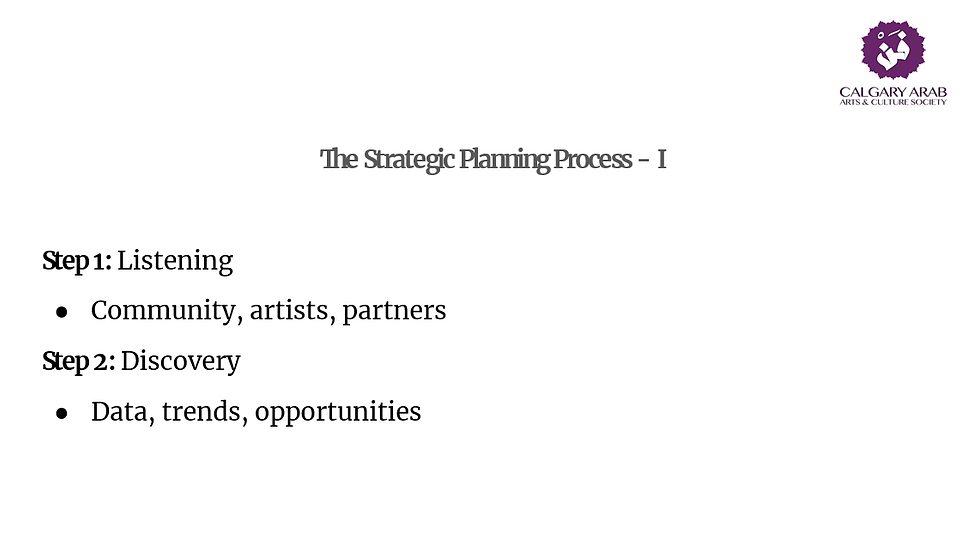


From the above, the strategic planning process is not an easy or one-time exercise. It is a process .. it is time consuming .. it intellectually rigorous .. and it is democratic in nature. Most important than the brainstorming and decision making, it is the decision taking. It is the following commitment and follow-up in order not to wither away or fall to the cracks. The democratic nature or involving all the interlocutors in the organizational well-being in order to play an integral part in the consistent implementation of the plan.
Here comes the possibility of culture eating strategy if not put into consideration in a conscious way. Hence, keep asking the right questions, keep reminding yourself of the raison d'etre .. and enjoy bragging when your plan pays fruition ..
Bassem Hafez, M.A.


Comments